Calculus 3 Sequences And Series. View lesson09, sequences and series.pptx from dao 1704 at national university of singapore. On the other hand, these are the first six terms of the decimal expansion of π, so this sequence can be extended to an infinite sequence, 3,1,4,1,5,9,., where it is understood from the context that we continue this sequence by computing further terms in the decimal expansion of π.
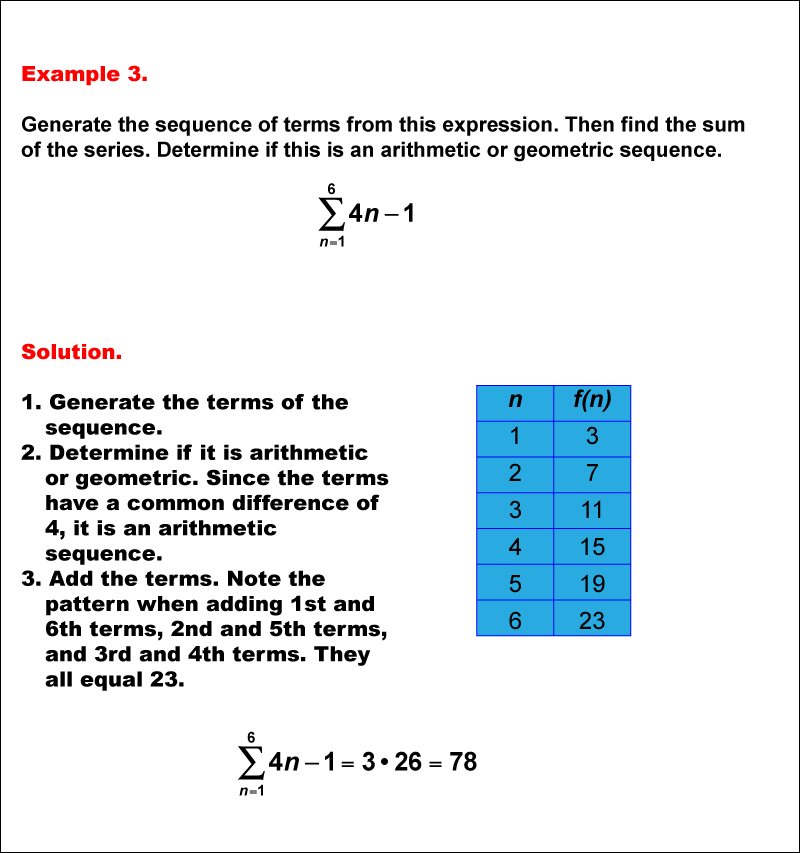
Math ExampleSequences and SeriesExample 03 Media4Math from media4math.com
The fibonacci sequence is defined recursively with two initial conditions: Series are sums of terms in sequences. 1 bpm1701 calculus and statistics lesson 9a sequences and series ap.
We Will Examine Geometric Series, Telescoping Series, And Harmonic Series.
Another strategy is to realize that the days can be summed in any order and the sum of the first and last day is the same as the sum of the second and second to last day, is the same as the sum of the third and third to last day, and so on. Sequences and series since finite sums and limits are both linear, so are series. As it turns out, if the sequence {s n} of nth partial sums for a series diverges, then so does the series.
The Ratio And Root Tests;
Since this sequence obviously diverges, so does the series. 1 bpm1701 calculus and statistics lesson 9a sequences and series ap. On the other hand, these are the first six terms of the decimal expansion of π, so this sequence can be extended to an infinite sequence, 3,1,4,1,5,9,., where it is understood from the context that we continue this sequence by computing further terms in the decimal expansion of π.
¥ Å N=0 1 +( N2) 32N ¥ Å N=0 3N.
Let’s look at the sequence of partial sums for the two examples above. Here, we have just substituted k for each value from 3 to 8. The sequence 3,1,4,1,5,9 has six terms which are easily listed.
A 3 = A 2 + 5 = [ (3 + 5) + 5] + 5 = 18, A 4 = A 3 + 5 = { [ (3 + 5) + 5] + 5} + 5 = 23.
Theorem 10.3.2 (linearity of series). These simple innovations uncover a world of fascinating functions and behavior. $\begingroup$ as far as i know, sequences and series are not needed in calc 3 or an introductory course of differential equations.
Video Answers For All Textbook Questions Of Chapter 11, Infinite Sequences And Series, Calculus Early Transcendentals By Numerade Limited Time Offer Unlock A Free Month Of Numerade+ By Answering 20 Questions On Our New App, Studyparty!
We can expand this equation as follows: An arithmetic progression is one of the common examples of sequence and series. For the geometric series example, s 1 = 1 2, s 2 = 1 2 + 1 4 = 3 4, and s n= 1 2 + 1 4 + 1 8 + 1 2n = 1 1 2n.